
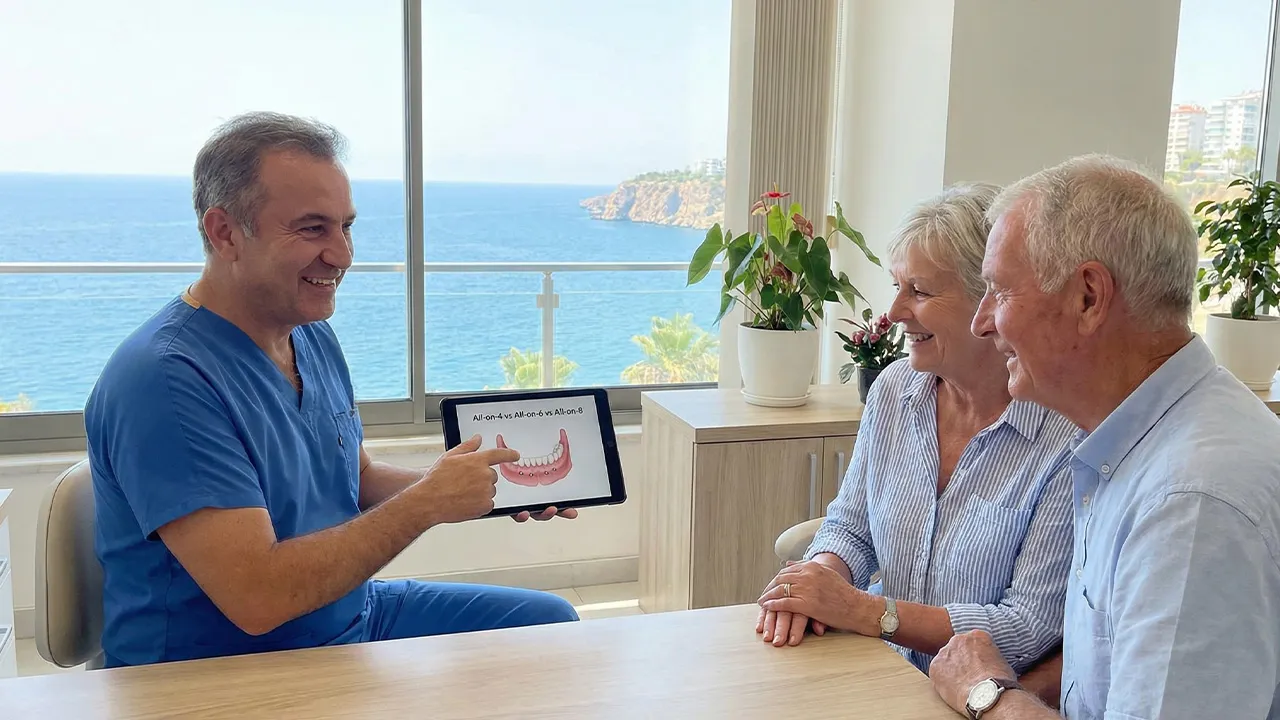
Choosing All-on-4 vs All-on-6 vs All-on-8 can feel like picking a number. In real life, the best match comes from your jaw anatomy, your bone strength, and how you bite every day. UK patients exploring dental implants Turkey often want clear answers on what changes between these options, how the process feels, and how to plan travel with confidence.
At Ultra Dental Turkey, we focus on scan-led planning, a stable bite, and a bridge that feels natural when you speak, smile, and eat. We have created this guide to explain each full-arch option in a straightforward way, so you understand what your jaw needs and why one approach can suit you better than another.
What All-on-4, All-on-6, And All-on-8 Mean
All three treatments are forms of full arch dental implants. They replace a full set of teeth (upper, lower, or both) using a fixed bridge that connects to implants placed in the jawbone. The name tells you how many implants support one arch:
- All-on-4 uses four implants
- All-on-6 uses six implants
- All-on-8 uses eight implants
More implants can spread chewing forces across more support points. At the same time, your bone map decides how many implant positions fit safely and comfortably. That is why the “best” choice looks different from person to person, and we always guide the plan using your scan and bite assessment.
The Official All-on-4 Concept And Its Key Features
The All-on-4 approach is an established full-arch concept using four implants to hold a fixed bridge. Many cases also suit an immediate temporary bridge when the implants achieve strong early stability. The feature that stands out most is the way the back implants are placed, and we use this method when your anatomy and planning support it.
Tilted back implants create smart support
All-on-4 typically uses two implants toward the front and two posterior implants placed at an angle. In clinical descriptions, that tilt can reach around 45 degrees depending on anatomy and planning. This angled design supports treatment where straight implants in the back of the jaw face limits, and we plan this carefully using your scan.
Why the tilt can matter for comfort and planning
Angled posterior implants can:
- reduce the need for bone grafting in some cases by working around key structures
- allow longer implants to engage more bone
- shorten the bridge overhang behind the last implant (often called cantilever reduction)
This is one reason many people looking at all on 4 dental implants Turkey see All-on-4 as a strong option for jaws with lower bone volume in the back, and we use the scan to confirm the safest placement strategy.
 All-on-6: When Extra Support Fits Your Bite
All-on-6 adds two more implants to the arch. That changes how chewing forces spread through the bridge and into the jaw. For many patients, this feels like a balanced upgrade when their bone volume supports it, and we often recommend it when bite demands call for wider support.
When six implants can suit you
All-on-6 often fits people who have:
- solid bone volume across the arch
- stronger bite forces
- a history of night grinding, where load sharing supports long-term comfort
It also appeals to patients comparing full mouth dental implants Turkey price options, because it can deliver extra stability while staying within a clear, practical plan that we shape around your scan results.
What changes compared to All-on-4
With more implants, each implant may carry less stress during chewing. The planning can also open more choices for bridge design. The trade-off usually comes through higher component count and a higher overall fee than All-on-4, and we explain these differences clearly during planning.
All-on-8: Maximum Distribution For Selected Cases
All-on-8 uses eight implants per arch, aiming for wide force distribution and added support points under the bridge. This approach suits patients whose bone volume supports eight well-spaced implant sites and whose bridge plan benefits from that extra anchorage, and we use scan-led mapping to confirm suitability.
When eight implants make sense
All-on-8 can suit cases where:
- the jaw has ample bone volume across the full arch
- the bite pattern places high demand on the bridge
- the treatment strategy gains stability from extra support points
Many patients still reach excellent results with All-on-4 or All-on-6 when the plan matches their anatomy. The number matters, and the scan and bite analysis matter even more, and we base the decision on those findings.
How To Choose The Best Option For Your Jaw
The right choice depends on four practical factors. At Ultra Dental Turkey, we use scans, bite checks, and bridge design to guide the decision and create a plan that fits your jaw and daily life.
1) Bone volume and bone density
Bone volume affects how many implant sites fit safely. All-on-4 often suits jaws with limited back bone thanks to angled implants. When your bone map supports more sites, All-on-6 or All-on-8 can become part of the solution strategy, and we align that strategy to your scan results.
2) Bite force and grinding
Clenching and grinding increase load on implants and bridges. In those cases, more implants can spread forces and support comfort. This is one reason All-on-6 often becomes a strong match for heavier bite patterns, and we assess this during your bite review.
3) Upper jaw vs lower jaw differences
The upper jaw can involve sinus space and different bone quality. The lower jaw often has denser bones. A scan shows where stable implant grip is most predictable, and that guides implant count and placement.
4) Bridge material and design
Bridge choices matter. Many full-arch plans include zirconia or acrylic-based options, and each material has its own feel and weight. Matching bridge design to implant distribution supports a more natural bite and a confident smile, and we guide this selection based on your goals and bite demands.
What UK Patients Can Expect When Travelling To Turkey
People weighing implant costs in Turkey want clear steps and a smooth timetable. A common pathway includes digital assessment, implant placement, and a fixed temporary bridge when early stability supports it. After healing, the final bridge follows based on how the implants integrate and how your case progresses, and we structure this pathway so UK patients can plan travel with clarity.
UK patients also value clarity on follow-up. A good plan includes cleaning guidance, check-up timing, and simple daily habits to protect your bridge. This is where the right clinic pathway matters as much as the implant number. Patients comparing a Turkey dentist often look for clear communication, proof standards, and a plan that still feels structured once they return home. Many people also compare clinic choices using terms like Turkey dental and dentistry in Turkey, and the strongest shortlisting approach comes back to planning quality and aftercare structure, and we remain fully committed to that standard. For UK patients looking to get clarity on standards, credentials, and aftercare systems, we recommend reading our detailed guide on how to verify a dental clinic in Turkey first.